Wednesday, September 10, 2014

England 2014

Sept 2014 Trip to England

Monday 8 Sept 2014
Plane landed early. We managed to get through customs and immigration quickly and pick up our luggage. Interesting hand drier UI in the washroom. There is one at each sink. Stick your hands under the mirror. There is an icon, but it was fun to watch people try to figure it out. No phone so no picture.

We were planning to take the Rail Coach to Reading and train from there to Bath. Elisa gave us great directions from Terminal 5, but we came into 3. No worries, we were directed to the central bus station where we were just in time to catch the next bus to Reading. Free WiFi on the “coach” – Whoo hoo!. Got to Reading in time to catch the 9:59 train to Bath with 10 minutes to spare. No WiFi on the train, tho’.

We got to Bath just after 11. We found a nice little cafĂ© across from the station to have a late breakfast – eggs and English muffins. Also got directions to the Apple store (really?? In Bath?) to find out where to get SIM cards – just around the corner. 15L for 2 GB data, 200 min and 2000 texts for a month. Not bad. Don’t lose the US SIM – taped to the folder.

Cab to the B&B. The room is very nice. Light and airy, and we can open the windows. Michael took a snooze while I fixed a knitting mistake. We’re off to see the Royal Crescent and the Roman Baths. And the Abby.

It’s been a while since we’ve traveled somewhere where there are a lot of tourists. Tour buses everywhere. The royal Crescent is at the top of Victoria Park. Very hard to get a picture with out doing a panorama.


We walked down hill towards the Roman Baths and the Abby. Michael was feeling the effects of a lack of sleep + jet lag, but hung in there. Like the Crescent, the Circus is a street with houses built in a crescent. There are 3 of them, creating a circle, with a park in the middle


The Circus

In the late 1700s and early 1800s Bath was a spa. People came to drink the waters for their health. I’m sure no one knew there were Roman baths buried under the Pump Room. If you are a fan of Jane Austen, you know she lived in Bath for several years. If you are a fan of Georgette Heyer, you know about the Assembly Rooms and the Pump Room. They are still here and you can visit them.

Bath Chimneys.

I had no idea the Roman baths were so extensive. I’m thinking military outpost, but no, the entire complex is much larger  than I expected. Not surprisingly, the baths are way below the current ground level, and excavations are still underway. Part of the complex lies under the Abby.

The Roman Baths – the Main Baths


The Bath Abby is next to the baths. It used to be a Cathedral, but the Bishop moved the Wells. Without a bishop, the church cannot be a cathedral. The vaulting is very unusual. Unlike the Gothic vaulting, this is fluted. I have never seen anything quite like it.

Fluted vaults at Bath Abby.


Michael is dragging so we found the information center and a brochure on restuarants. There is a Moroccan place a couple of blocks away.  The food is very good and we grab a cab back to the B&B. We are asleep by 8 PM.

Tuesday 9 September

Stonehenge is on the itinerary for today, but first we have to pick up the car. We have not driven on the left since 1995 when we went to New Zealand. And that was mainly back roads. This should be interesting. The car is new – a Renault “Captur”. Bright blue. At least we can find it in a parking lot. It’s a diesel, which is good. Diesel prices are cheaper.
We set off for Salisbury and the cathedral. The plan is is to have lunch there and get to Stonehenge by 2:30 – 3:00. The roads are narrow and we’re driving a lot slower than the speed limit. But we get to Salibury by noon,find a parking lot, and do the short walk to the cathedral. The spire is the tallest one in Britain. It was added after the cathedral was built. The weight has caused the columns to bend and the spire is now leaning out of plumb.

The guides are super – clearly they love what they do. We could have spent more time listening to all they had to share, but we had the 2:30 time at Stonehenge. The cathedral is huge. There are 2 transepts. Not all built at the same time. The stained glass was removed at one point as they tried to get more light into the cathedral. They were able to salvage some of it and create new windows at the west and.


Salisbury Cathedral.


Salisbury Cathedral towards the altar.

As you can see, the vaulting is quite different from Bath Abby.


Vaulted ceiling at Salisbury.

They have a very nice restaurant (refectory) at the Cathedral. Here the view through the glass ceiling.

=

View from the refectory.

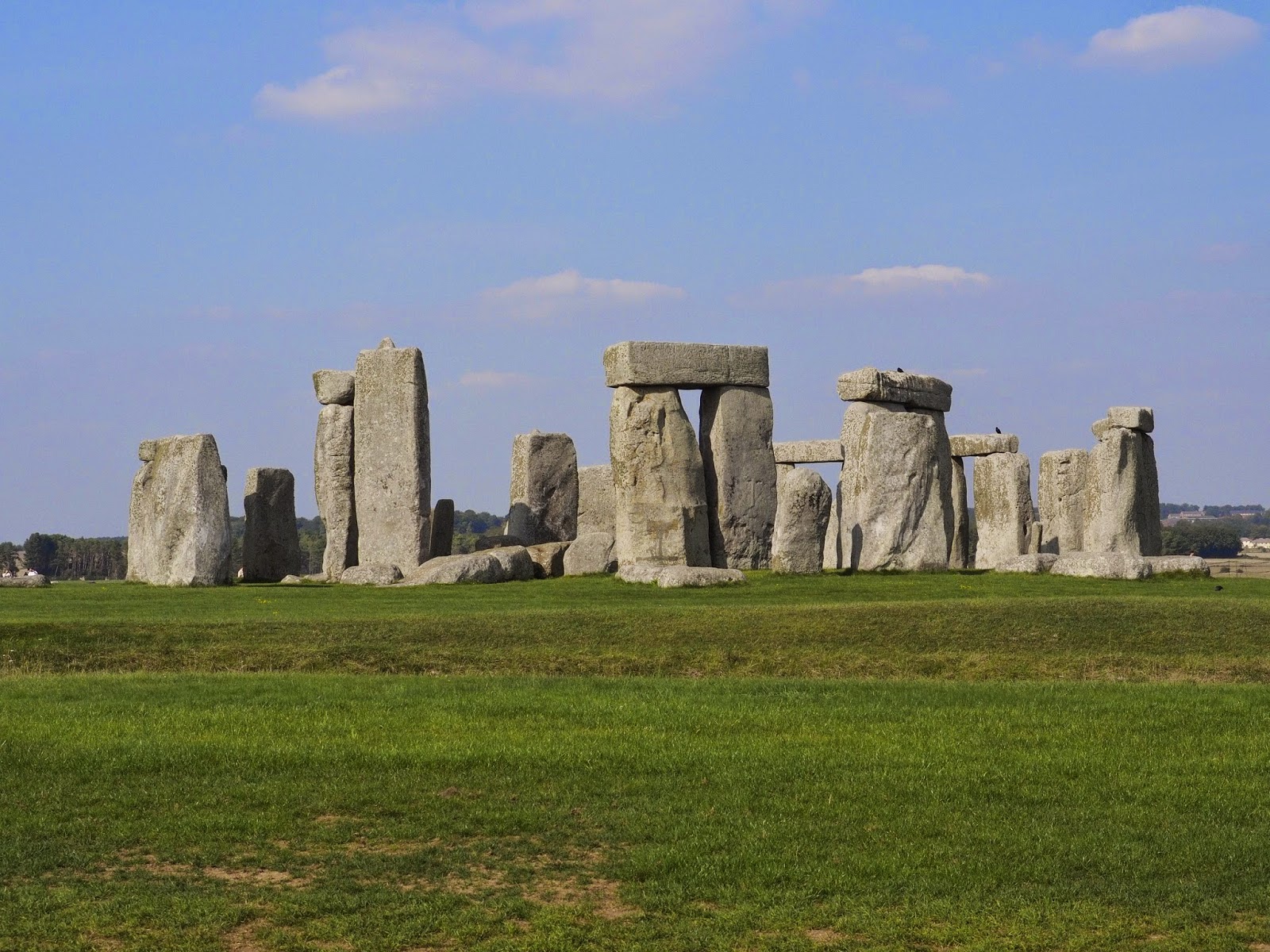
Off to Stonehenge. The British are not that impressed with the place. They miss being able to walk among the stone, but with 1M visitors a year, that’s impossible. The new visitor’s center is great and the new paths should get you closer than the current temporary ones. It’s still a cool place. Warm, sunny afternoon. Very un-English.

We walked the whole circuit and took lots of pictures. It’s hard to choose just one. Every angle is different.


One thing they do at the visitor center is show a 360 deg video from inside the circle, so you get some sense of what it’s like.


Off to Avebury and Wells today. 

Monday, October 17, 2011

Bhutan wrap up

We got home Friday night to a dark house. Based on my TIVO recordings, we lost power about the first of October. Needless to say, the refrigerator and the freezer stank to high heaven. We called DP&L about the outage and went to a hotel for the night. Saturday the power had been restored and we spent the day cleaning out the fridge and freezer.

I really enjoyed the trip. It was a bit rough on Michael between the steamy weather in Bangkok and the bout of tourista, but he also found it interesting.

Bhutan is a small country with only 700,000 people. There are no cities as we know them. They are trying to balance development with maintaining their traditions, which is not easy. New buildings have to use the traditional structure and decorations. People who work with the pubic have to wear traditional dress. But there are satellite dishes on houses in even rural areas. Houses in towns are heated with electricity. People in in rural areas where electricity may not be reliable are allowed to cut down 2 trees per year for heating. They are proud of the fact that 70% of the country is forested. Protecting the environment is one of the goals for Gross National Happiness.

The biggest export is hydroelectric power, which they sell to India. They have 5-6 more hydro projects in the works. The heavy trucks are tearing up the roads as they bring construction materials from India and from quarries in the mountains. Buckwheat is another export.

In 2010 they had 40,000 tourists - more than 5000 more than anticipated. Considering the population of 700,000, this is a lot. They have some control over the number of people from outside in that there are only 3 flights in and out a day and a visa is required. One article in the Druk Air magazine talked about how only guests of the royal family were originally allowed into the country. Gradually, they started allowing others in, but at a high cost - $200 per day. But this rate has not kept up with inflation (it goes to $250 a day next year)  and now there are a lot more people arriving. And these people have expectations about hotels, restaurants, etc that are bound to change the atmosphere. There are no McD's or KFCs, but you have to wonder how long that will last. You can get Lay's potato chips and Coke.

I am also still struggling with the photography issue. Those of you who followed last year's trip may remember my quandary about photographing people. I like to capture an image as a memory for me and to share with others. But I still have trouble with that feeling that I am treating these people like an exhibit - like animals in the zoo. Dick had an interesting analogy. Imagine yourself working in your garden and a group of aliens lands in a spaceship and the leader asks if they can watch you and take photographs. They hang around for 20-30 minutes, clicking away, then hop back into the spaceship and take off. While these people have certainly seen tourist buses before, it still feels intrusive to me. Many of the kids seemed to enjoy having their pictures taken and asked to have prints sent to them.

I took more pictures than usual. I played around more with exposures and composition. I'm going to have to sit down and filter, process and create albums before I can share more of them. And there were still photos that I would have liked to have taken given more time, better light, etc.

I hope you enjoyed following the trip. 

Friday, October 14, 2011

Last morning in Paro

We spent 2 days in Paro - or actually two nights. The first day we went up to Tiger's Nest. Since our flight was delayed we were able to do some more shopping and watch part of an archery tournament. Archery is the national sport of Bhutan. They compete with both traditional bows made of bamboo and the newer compound bows that are used in international competition.


The target is quite small - a circle about a foot in diameter drawn on a white board that measures about 15 inches across and maybe 2.5 ft high. You get 1 point for hitting the board and 3 for getting an arrow in the circle. The target is 180 - 200 meters from the archer. Amazing that they ever hit it. 


One left-handed archer enabled me to see the front of him. 


Chimmi said that this was part of a national tournament, but it was not clear whether this was a regional event leading up to the nationals, or the actual national tournament. There were 3 teams competing, each with 5 members.

If a team member hits the target there is a victory dance and song at both ends of the field. Each team shoots 3 arrows, then they move to the opposite end. One of the flags was in the way, but can get the idea.


Thursday, October 13, 2011

People at work

I realized I had not posted anything about the people we saw working in Bhutan. While there is some heavy machinery for the road work and quarrying, most of the work is done by hand. We saw a family using a brace of yaks to plow their fields in the Ura valley.


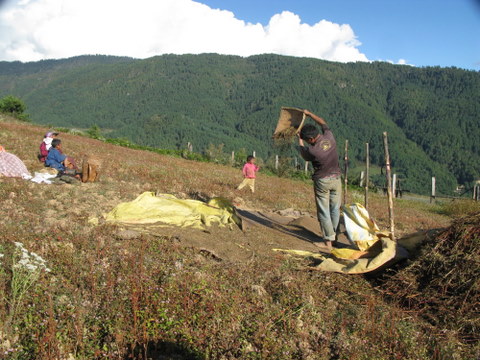
Later that afternoon we saw another family threshing their buckwheat. The man was doing all the work and his wife and 3 children were there, watching. He used the large basket to separate the buckwheat grains and the flat basket to scoop up the grain and put it in the sacks.


There is an infant in the mother's lap, although you can't see it in this picture. See below. 


Here he is using the flat basket to shovel the grain into the sack. 


Here' are the mother and her youngest. Families are encouraged to have no more than 2 children, but there is no enforcement. In this province and at this altitude, most people survive on subsistence farming. Buckwheat is about the only thing that grows up here. Chimmi said there were sheep and we did see some weaving with wool, but I never saw the sheep. 


I'm not sure that I mentioned that Bhutanese society is quite different than Western society in terms of inheritance. The man moves in with his wif'e's family and the daughters inherit the property.

We also watched a woman with a hand scythe cutting buckwheat. These were situations where we noticed someone working in the field and we asked Chimmi to talk to the people and ask if it was OK to photograph them. Everyone was fine with it.


This is also the beginning of the season for the rice harvest. We saw a couple of fields where the rice had been cut and one where the threshing had begun, but we didn't have time to stop and photograph.

Weaving is prevalent in the northeast, but I found a few women weaving in the shops. I was in this shop one evening and the weaver had gone home, but she was there in the morning two days later. She was very fast. Most of the patterns are standard pickup and inlay, but there is also the use of what looks like a sumac weave that I originally thought was embroidered.


Tuesday, October 11, 2011

11 October - Tiger's Nest

Tiger's Nest is the iconic photograph of Bhutan. It is another monastery built in the 17th century. According to Buddhist tradition, the Guru Rinpoche flew to this location back in the 7th or 8th century on the back of a tigress. He meditated in a cave for 3 months. This cave is now one of the most holy temples in Buddhism. The Tiger's Nest burned in 1998 and all the woodwork has been restored - and embellished.

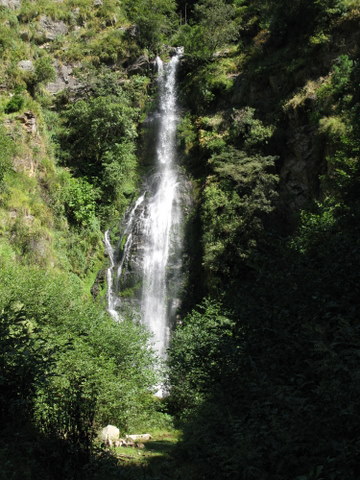
There was some debate among the group as to the actual altitude of  the Tiger's Nest (10,200 ft. - or 2300 ft above the valley floor) and how far we would have to climb. About half of us opted to ride horses or mules. We were put to shame by Edith, who is 78 and has now walked up twice in the past 3 years. Even Dick was able to get to the look-out under his own power. The views are spectacular and who knows how they managed to get those prayer flags strung over the chasm. This is the view from half-way donw the stairs. Thank good ness they have widened the staircase and added railings. No way could I have gotten down without the railings. You walk down one side of the chasm, cross a bridge at the foot of the waterfall and climb back up the other side. At 10k ft, you stop every few steps.


I think I shot these prayer flags from the terrace at the entrance to the monastery. I also shot a video which give a much better sense of the wind whipping through here. 


This was shot on our way back up the steps. Later hour and better light. 


The horses will take you to the look out, but then there are still 400 hundred steps down and up to the monastery. No electronics allowed in the monastery, so no photos of the inside. The horses share thepath with the humans and travel in groups. I rode a mule. Some of the horses were a bit

The travel company had arranged for us to have lunch just down the path from the look out. There wa an unfortunate incident when one of the dogs bit a local woman who got to close to its food. We patched her up as best we could and tried to impress on her the importance of seeing a doctor ASAP, but who knows whether any one will follow up.

The hike down was rough on Michael's knees, but he made it.

OUr flight out tomorrow has been rescheduled to the afternoon. With only 3 flights a day, they can be flexible. We have heard that there is major flooding in Bangkok that is supposed to peak next week. Our hotel is not near the river, but it could put a crimp in my plans to get to teh fabric market. Chances are the boats are not running. We'll see. 

Monday, October 10, 2011

10 October Whang Du to Paro

Breakfast at 6:30 and underway at 7:30. We planned a stop at the cafeteria at Dashu La - the pass with the 108 stupas. Tea and cookies. The first cookies we have had since we left home. It was a nice treat. Then we got hung up photographing a Bhutanese tea pot. Michael got an interesting shot - I'll have to get him ot post it.

We had lunch in Thimpu and everyone actually got back to the bus on time. We hit the ATM to make sure we had adequate money to tip Chimee and Tandin. Then off to Paro to visit another Dzong, more shopping and another early night. This hotel is unreal. The room is huge - complete with seating area, a balcony overlooking the valley and a bath with both bath and shower.  Feels weird. Thimphu felt very strange after a week in the rural areas or central Bhutan. There is a lot of construction - new housing going up everywhere. And lots of prep for Friday's festivities surrounding the royal wedding.

I've decided to go with the horse tomorrow. It's a 2 hour hike at best. And even if you take the horse up, you have to walk down. I hope to get time to post some photos tomorrow. Still need to buy a silk under-blouse for the kira. 

Jakar to Whang Du


9 October

Jakar to Whang Du

We got up early because this was going to be a long drive. We wanted to stop on the way out of town to take photos of some chili peppers drying on mat and wooden roofs. All our other photos were on metal roofs. Side note - most modern roofs are metal. New ones are very shiny. There is a law that you have to paint your roof after a few years, but  the only approved colors are red and green. Most people seem to choose green. We got some good shots and headed out of town. Most of the shingle roof are like this - held down with rocks.


This is the 4th time we have been over this road, since we went back to the weaving center on Wednesday to take some rural shots and so I could pay my bill. They actually let me take the items I bought with the understanding that I would pay when we came back through. Tells you something about the difference in the trust factor between the US and Bhutan.

We made a few stops to stretch our legs and take some photos. Gail has a thing about stupas so we had to stop at a couple of those. There were also a couple of rest stops. The Thais refer to the restroom as the "happy room". We have adopted Edith's term for an unofficial toilet - the "happy bush". We had lunch at a new restaurant - less than 2 years old. They had western style toilets - complete with paper and flush. Whoo hoo.


This is one of the trucks from India. These drivers love to decorate their trucks. They transport all kinds of goods back and forth.

What with all the stops, we got into Whang Du at about 5:45. There were some interesting rice paddies along the way, but the light was fading and we wanted to get in by 6:00. Tandin, our driver did some amazing driving through the washout area. There was a backup and one-way traffic. Huge potholes. He is an outstanding driver. And only in his 20s. 

We are staying at the Kichu Resort. It appears to be run by an Indian family as  the restaurant is vegetarian. Alongside a river that we are hoping to see in the morning. Departure tomorrow is 7:30. We get to sleep a whole half hour later. The restaurant was out of several drinks, so we had beer. The bar was well-stocked however. Interesting. We have a riverside room. Nice white noise. A contrast with the barking dogs at the Jakar Village Hotel. 

Next stop Paro where we will climb up to the Tiger's Nest on Tuesday. It's a steep climb and takes a couple of hours. I'm thinking about taking the horse option. Not much shorter, but at 8500 ft, I'm not sure I want to risk problems with the altitude.